Poker Cards: Rules, Types, Ranking & Beginner’s Guide
Poker cards are used in one of the world’s best-known card games, combining strategy, probability, observation, and decision-making. Whether someone is learning poker for the first time or exploring different poker card games, understanding the deck, hand rankings, and basic rules provides a strong starting point.
This complete poker cards guide explains how poker works, the different types of poker games, standard card rankings, and essential tips for beginners.
What Are Poker Cards?
Poker cards are standard playing cards used to play several variations of poker. A traditional deck contains 52 cards divided into four suits: hearts, diamonds, clubs, and spades. Each suit contains 13 cards, including an ace, numbered cards from 2 through 10, and four face cards: jack, queen, and king.
In most traditional poker games, the suits have equal value. The strength of a poker hand depends on its combination of cards and the rules of the particular game.
Poker can be played casually with friends, in organized tournaments, or through online platforms. Rules, entry requirements, and legal restrictions vary depending on the location and platform.
How to Play Poker Cards
The exact rules depend on the poker variation, but most games follow a similar structure. Players receive private cards, community cards may be dealt, and players make decisions during betting rounds.
A typical poker game includes the following stages:
- Dealing: Players receive cards according to the game’s rules.
- Betting: Players may check, call, raise, or fold when those actions are available.
- Community cards: In games such as Texas Hold’em, shared cards are placed face up on the table.
- Final betting round: Players make their final decisions based on the available information.
- Showdown: Remaining players reveal their hands when required, and the strongest eligible hand wins under the applicable rules.
Not every poker game uses community cards or the same number of betting rounds. Learning one variation at a time makes the rules easier to understand.
Poker Card Rankings Explained
Understanding poker card rankings is essential because hand strength determines the winner in many poker variations. In standard high-hand poker, the usual rankings from strongest to weakest are:
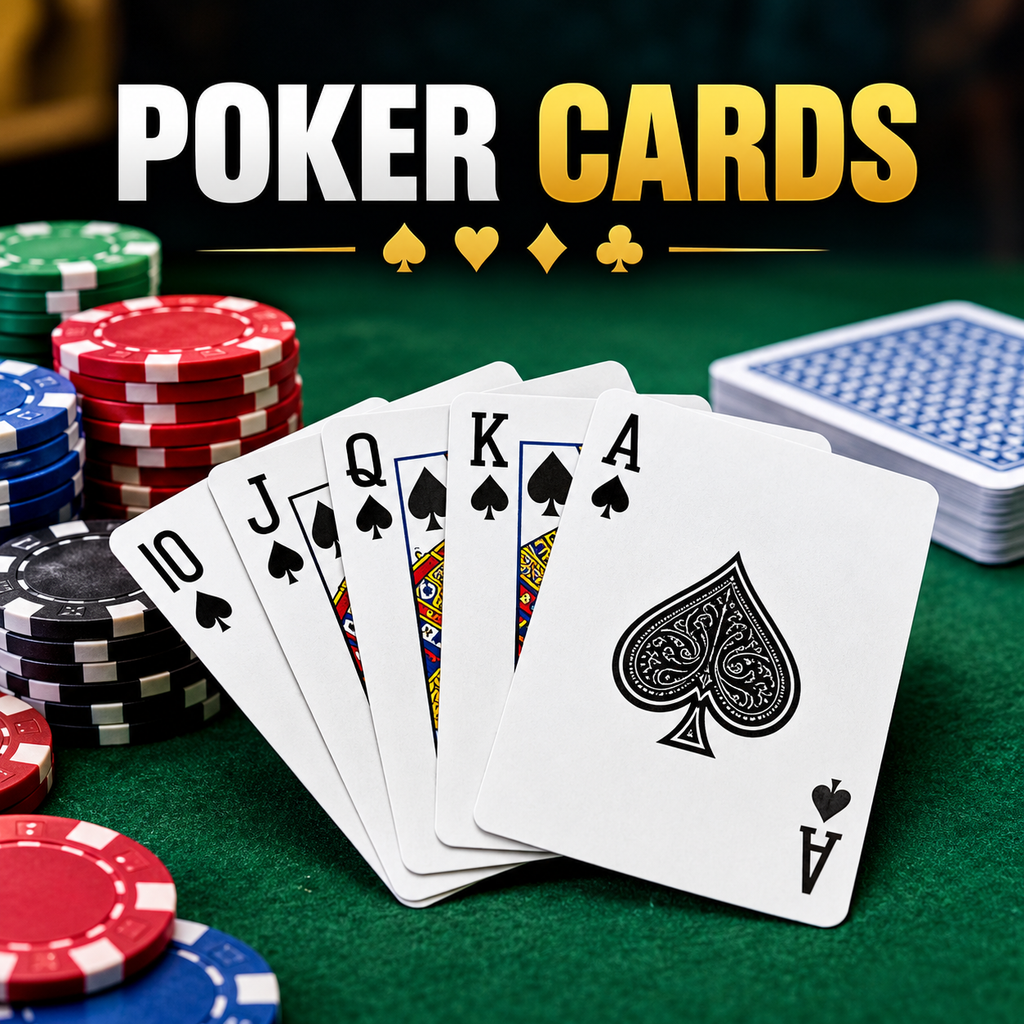
1. Royal Flush
An ace, king, queen, jack, and ten of the same suit form a royal flush. It is the highest standard poker hand.
2. Straight Flush
Five consecutive cards of the same suit form a straight flush, such as 5, 6, 7, 8, and 9 of hearts.
3. Four of a Kind
Four cards of the same rank form four of a kind, such as four queens.
4. Full House
A full house contains three cards of one rank and two cards of another rank, such as three kings and two eights.
5. Flush
A flush contains five cards of the same suit that are not all consecutive.
6. Straight
A straight contains five consecutive ranks in different suits or a mixture of suits. An ace may be high or low in a straight, but it cannot wrap around between king and two.
7. Three of a Kind
Three cards share the same rank, such as three jacks.
8. Two Pair
Two pair contains two cards of one rank, two cards of another rank, and an additional card.
9. One Pair
One pair contains two cards of the same rank, such as two tens.
10. High Card
When no qualifying combination is made, the hand is evaluated by its highest cards.
Some poker variations use different hand-ranking rules, so players should check the rules before starting a game.
Popular Types of Poker Card Games
Texas Hold’em
Texas Hold’em is a widely played poker variation. Each player receives two private cards and can use five community cards to form the best five-card hand.
Omaha Poker
Omaha resembles Texas Hold’em but usually deals four private cards to each player. Players must use exactly two private cards and exactly three community cards to make their hand.
Seven-Card Stud
Seven-Card Stud does not use community cards in the same way as Texas Hold’em. Players receive a combination of face-up and face-down cards and make the best five-card hand.
Five-Card Draw
In Five-Card Draw, each player receives five private cards and may have an opportunity to exchange some cards according to the rules. It is often a straightforward variation for learning basic poker concepts.
Essential Tips for Poker Beginners
Learning poker card rules is only the first step. Beginners should also develop sound habits and understand that card games involve uncertainty.
- Learn the rules first: Understand the hand rankings and betting actions before joining a game.
- Observe the game: Pay attention to how the betting rounds and showdown work.
- Practice with no-money games: Free-play modes can help beginners learn without financial risk.
- Understand probability: A strong starting hand does not guarantee a win.
- Set clear limits: Avoid risking money needed for essential expenses.
- Choose reputable platforms: Check platform security, privacy policies, age requirements, and local laws before playing.
Poker involves chance as well as strategy. No system or strategy guarantees consistent winnings.
Poker Cards in Online Games
Online poker platforms may offer tutorials, practice tables, tournaments, and different game formats. Features vary by provider, region, and device.
Before choosing an online poker game, check whether it is available legally in your location, whether it requires an account, and whether real-money participation is involved. Read the platform’s terms and conditions before installing an application.
For more gaming information, readers can explore our Latest Games and Game Guides sections. If the website provides an appropriate safety resource, link to the APK Installation Guide for general advice about checking application sources and permissions.
Are Poker Cards Suitable for Beginners?
Poker can be learned by beginners who start with the basic rules, card rankings, and simple game variations. Five-Card Draw can be a useful introduction, while Texas Hold’em provides a common next step.
Practice games with no real-money stakes allow players to understand gameplay without financial pressure. Anyone considering real-money poker should first review applicable laws, platform requirements, and personal spending limits.
Frequently Asked Questions About Poker Cards
How many cards are in a standard poker deck?
A standard poker deck contains 52 cards divided into four suits, with 13 cards in each suit. Some decks also include jokers, which are not used in many standard poker games.
What is the strongest poker hand?
In standard high-hand poker, a royal flush is the strongest hand. It consists of an ace, king, queen, jack, and ten of the same suit.
Which poker game is easiest for beginners?
Five-Card Draw is often considered approachable because its basic structure is relatively simple. Beginners can also learn Texas Hold’em using free-play games and tutorials.
Are poker cards and playing cards different?
Poker cards are generally standard playing cards used in poker. The same 52-card deck can also be used for many other card games.
Can poker be played online?
Yes, poker is available through various online platforms. Availability, age restrictions, and rules for real-money play differ by location, so users should check local requirements and the platform’s terms.
Is poker only a game of luck?
Poker involves both chance and strategic decisions. The cards dealt are uncertain, while decisions about betting and hand selection can influence the outcome. No strategy guarantees a win.
Final Thoughts
Poker cards provide the foundation for several popular card games, from Texas Hold’em and Omaha to Five-Card Draw and Seven-Card Stud. Understanding card combinations, hand rankings, and the basic flow of a game helps new players learn confidently.
For beginners, the best approach is to start with the rules, practice without real-money stakes, and use reputable sources for game information. Always check local laws and platform requirements before participating in online poker.